The premise
Prompt quality is necessary. It was never sufficient.
Modern AI agents plan, retrieve knowledge, call tools, remember interactions, coordinate work, and act inside business processes. Once an AI system moves beyond a demonstration, reliability depends on far more than how its initial instruction is phrased.
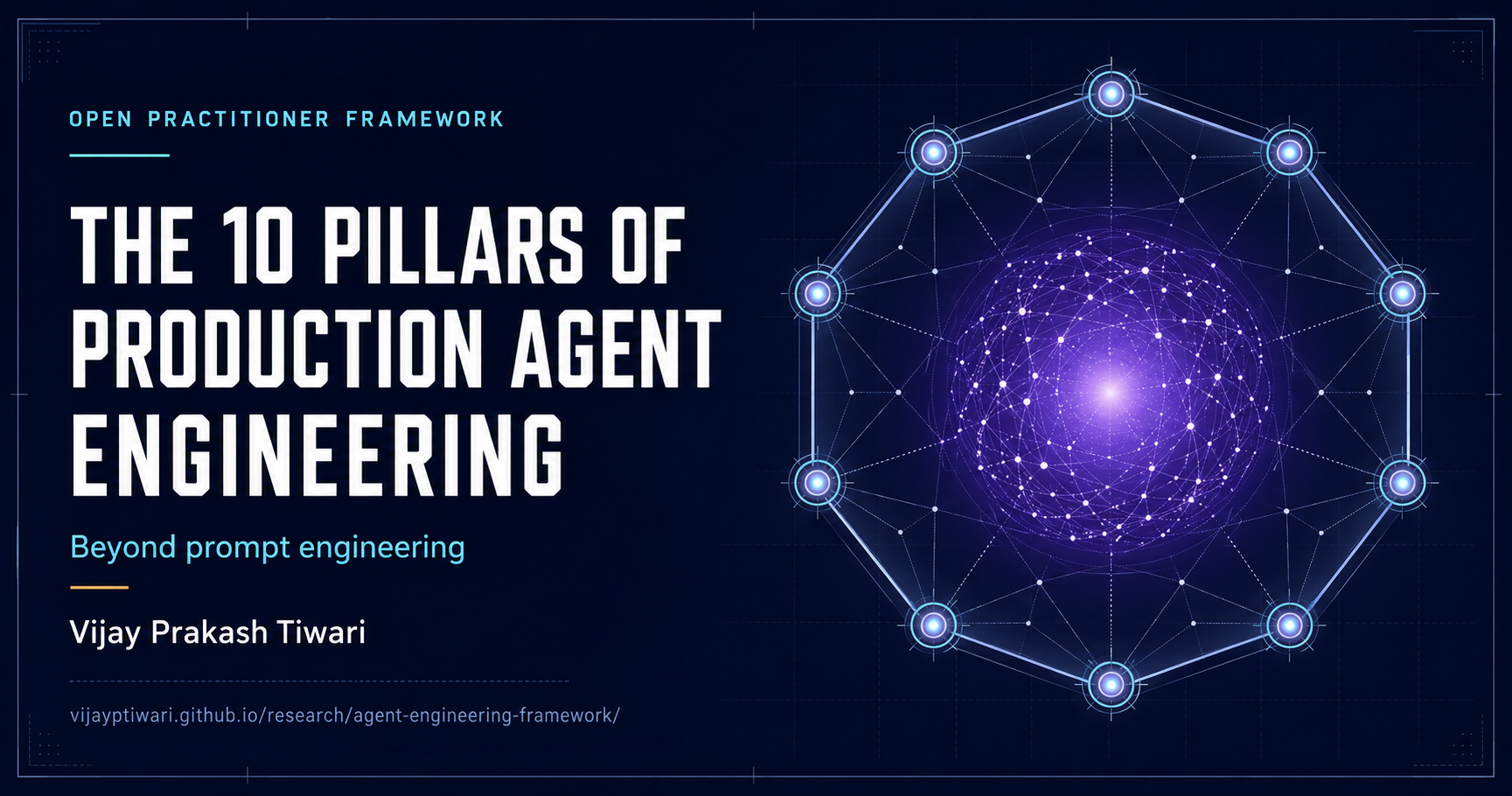
The framework reframes production agents as a systems-engineering problem. The language model supplies a probabilistic reasoning core; explicit engineering controls around it define success, constrain action, manage state, make execution durable, and measure whether the system is actually improving.
A production agent is not Prompt + LLM. It is a deterministic engineering envelope around a probabilistic core.
The framework
Ten coordinated control surfaces
Each pillar addresses a different design question, failure mode, and set of observable metrics. The value comes from treating them as a coordinated system rather than isolated techniques.
A foundational distinction
Goal, plan, and trajectory are not the same thing
A goal defines the desired end state, acceptance criteria, stopping conditions, and trade-offs. A plan describes the intended path before execution. A trajectory is what actually happens: model calls, tool invocations, observations, branches, retries, and corrections.
Two agents can share the same goal and plan while producing very different trajectories—and very different reliability. Production engineering therefore has to evaluate both the final outcome and the path that produced it.
Delivery lifecycle
From specification to continuous improvement
The pillars map onto six delivery phases. The sequence makes two priorities explicit: specify before prompting, and evaluate before deployment while continuing to evaluate in operation.
- 01SpecifyGoals and governance
- 02DesignTrajectory, context, tools, intelligence
- 03BuildPrompts, execution, and memory
- 04EvaluateDatasets, benchmarks, and regressions
- 05DeployGates, logging, budgets, and rollout
- 06OperateMonitor, curate, and re-benchmark
Practitioner tools
Turn the framework into design and release gates
The paper is accompanied by artifacts intended for real engineering conversations rather than passive reading.
The readiness rubric scores each pillar from 0 to 5. A total below 30 out of 50—or any score of 0 or 1 in Execution, Governance, or Evaluation—indicates a prototype rather than a production-ready system. The companion checklist turns each pillar into concrete pre-deployment questions.
Worked applications
Three systems viewed through all ten pillars
Contribution and limits
A practical synthesis—not a claim to have invented every discipline
Prompting, retrieval, memory, tool use, routing, governance, and evaluation all have established research and practice. The contribution is the synthesis: a coordinated, teachable, production-oriented vocabulary that teams can use to design systems, surface gaps, assign ownership, and assess readiness.
The framework is a practitioner synthesis, not an empirical result. It has not yet been validated through controlled comparisons that correlate rubric scores with production outcomes. Pillar boundaries are pragmatic, and large multi-agent economies may require additional coordination concepts.
Open artifacts
Read the paper and apply the framework
Related research
From the broad framework to one testable control boundary
Evidence-Grounded Agent Routing develops one part of the broader framework into an executable, benchmarked proposal: how an agentic system should justify, constrain, record, and evaluate delegation decisions.