
Configuration
application.yml, environment variables, Helm values, Maven profiles, and deployment modes.
Core properties
eventore:
  deployment-mode: ADMIN    # ADMIN | DEV | READONLY
  enabled-protocols:        # optional comma list; empty = all on classpath
  control-plane:
    auto-register-on-startup: true
  data-plane:
    require-control-plane-registration: true
  dev:
    allowed-protocols:      # DEV only: subset of registered protocols
      - KAFKA
      - KINESIS
    max-publish-bytes: 65536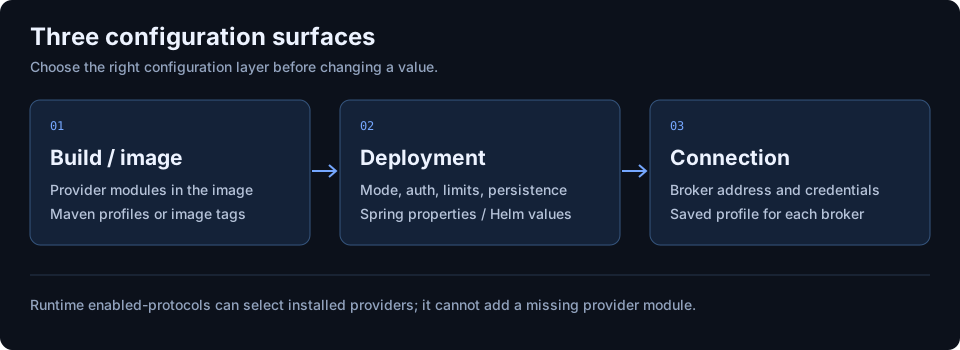
Deployment modes
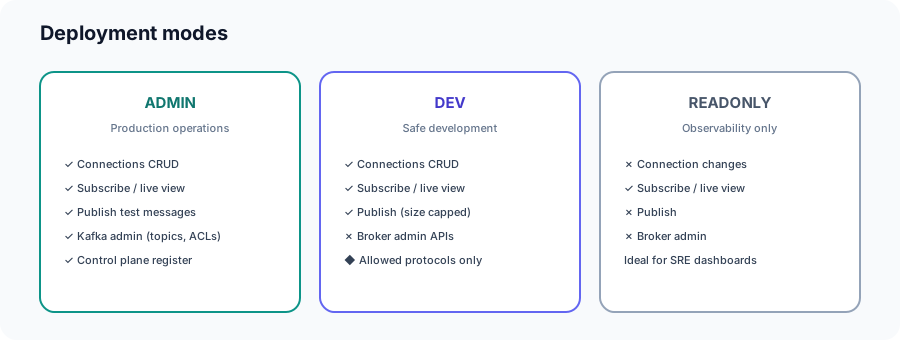
| Mode | Connections | Subscribe / live | Publish | Broker admin |
|---|---|---|---|---|
ADMIN | CRUD | Yes | Yes | Yes (Kafka topics, ACLs, …) |
DEV | CRUD | Yes | Yes (size capped) | No |
READONLY | Read-only | Yes | No | No |
In DEV, only protocols listed under eventore.dev.allowed-protocols are accepted, intersected with control-plane registration.
Enabled protocols (runtime)
Limits which providers bootstrap registers and which appear in GET /api/v1/config → supportedProtocols.
# Environment
EVENTORE_ENABLED_PROTOCOLS=KAFKA,KINESIS

# Spring
eventore.enabled-protocols=KAFKA,KINESIS
Valid values: KAFKA, PULSAR, RABBITMQ, MQTT, JMS, KINESIS, GCP_PUBSUB, AZURE_SERVICE_BUS.
Maven profiles (build time)
| Profile | Providers on classpath |
|---|---|
providers-all (default) | All eight modules |
kafka-kinesis | Kafka + Kinesis |
provider-kafka | Kafka only |
provider-kinesis | Kinesis only |
mvn -DskipTests -Pkafka-kinesis -P!providers-all packagePair with Spring profile kafka-kinesis in application-kafka-kinesis.yml for defaults.
Helm: stream providers
Required list eventore.streamProviders drives runtime enabled-protocols, DEV allowed protocols, and the backend image tag. See published artifacts.
eventore:
  streamProviders:
    - KAFKA
    - KINESIS
  deploymentMode: ADMIN
  connections:
    persistence:
      enabled: false
      volumeType: emptyDir   # or pvc + size / existingClaim
  security:
    apiToken: ""             # or apiTokenExistingSecret
    allowedOrigins: "*"
Image tag auto-derived from the chart application version: 0.2.1-kafka-kinesis. Eight providers use 0.2.1-all.
helm install eventore ./deploy/helm/eventore \
  -f deploy/helm/eventore/values-kafka-kinesis.yaml
Custom Docker build:
docker build -f docker/Dockerfile.backend \
  --build-arg EVENTORE_STREAM_PROFILES=kafka-kinesis .
Control plane API
# Snapshot (revision, providers, UI cascade)
GET /api/v1/control/plane

# Register at runtime (ADMIN)
POST /api/v1/control/providers/KAFKA/register

# Deregister
DELETE /api/v1/control/providers/MQTT/register
Embedded in config for the UI:
GET /api/v1/config
# → controlPlane.uiCascade.connectionProtocols
# → controlPlane.uiCascade.inspectProtocols
# → controlPlane.uiCascade.adminProtocols
OpenAPI catalog
Active stream contracts for this deployment:
GET /api/v1/openapi/catalogPer-stream YAML is served under /openapi/streams/{id}-api.yaml when that provider is registered. Streams include core, inspect, diagnostics, kafka, and kinesis.
Runtime configuration reference
Defaults below come from EventoreProperties and application.yml. Helm uses camelCase values and renders Spring’s kebab-case property names into SPRING_APPLICATION_JSON.
eventore.deployment-mode· DEV- Sets allowed operations. Helm:
eventore.deploymentMode. eventore.enabled-protocols· empty- An empty value selects modules on the classpath. Helm derives this from
eventore.streamProviders, whose chart default is[KAFKA]. eventore.subscriptions.max-concurrent· 50- Concurrent subscription limit. Helm:
eventore.subscriptions.maxConcurrent. eventore.subscriptions.queue-capacity· 500- Per-subscription buffering capacity. Helm:
eventore.subscriptions.queueCapacity. This is not durable broker storage. eventore.dev.max-publish-bytes· 1048576- Dev-mode payload size limit (1 MiB). Helm:
eventore.dev.maxPublishBytes. eventore.max-publish-bytes· 10485760- General publish size limit (10 MiB). The bundled chart does not expose a separate value for this property.
eventore.connections.persistence.enabled· false- Enable durable profile storage explicitly. Helm’s file path defaults to
/data/connections.json. eventore.security.api-token· empty- Empty disables static token authentication. Use a nonempty secret for authenticated deployments.
eventore.security.allowed-origins· *- Comma-separated browser origins used for CORS and WebSocket checks. Helm:
eventore.security.allowedOrigins.
Authentication and browser configuration
The API accepts Authorization: Bearer TOKEN or X-API-Key. The token is shared API authentication, not per-user identity or role-based authorization. Broker credentials are still required in each profile.
curl http://localhost:8080/api/v1/config -H "Authorization: Bearer YOUR_TOKEN"In the console, use Settings to enter the token. Avoid embedding it in static frontend configuration. For Helm, reference an existing Kubernetes Secret with eventore.security.apiTokenExistingSecret; see the deployment example.
Docker frontend runtime variables are EVENTORE_API_BASE_URL and EVENTORE_WS_URL. Helm equivalents are frontend.env.apiBaseUrl and frontend.env.wsUrl. The default Helm WebSocket URL is wss://[ingress.host]/ws/stream; override it when using an HTTP port-forward.
Development preview: JWT authentication
The 0.3.0 development branch adds HS256 shared-secret JWT validation. Spring properties are eventore.security.jwt-enabled, jwt-secret, jwt-issuer and jwt-audience under eventore.security. A signing secret and expiration are required. OIDC discovery, JWKS and enterprise login are not implemented. Operation permissions intersect identity roles with deployment mode. Workspace-based resource isolation is not implemented.
Development preview: workspace catalog
Workspace metadata is in memory and the header selection is stored in the browser. Connections, bridges and streams are not scoped to that selection. Do not use it as tenant isolation.
Development preview: local distribution bus
The development branch adds local fan-out and /api/v1/cluster/status. Redis networking and shared subscription routing are unfinished. Keep eventore.cluster.mode at LOCAL; use a single backend replica.
Run a JAR with explicit Spring configuration
Save a dedicated configuration file rather than assuming a Helm values file can be read by Spring:
eventore:
  deployment-mode: DEV
  enabled-protocols: MQTT
  subscriptions:
    max-concurrent: 10
    queue-capacity: 200
  security:
    api-token: ${EVENTORE_SECURITY_API_TOKEN}
    allowed-origins: "http://localhost:5173"
Set EVENTORE_SECURITY_API_TOKEN in the process environment, then pass the file location when starting the built JAR:
java -jar backend/eventore-server/target/eventore-server-0.2.1.jar --spring.config.additional-location=file:./eventore-local.ymlRestart the backend after changing deployment configuration. Verify the effective mode and protocol list with GET /api/v1/config. Changing a connection profile is a separate operation.
Diagnostics API
GET /api/v1/diagnostics/subscriptionsSubscription health for the dashboard; requires API token when eventore.security.api-token is set. Documented in diagnostics-api.yaml.
Related: Control & data plane · Deployment